Features
Keep it, strip it, or strip just the GPS.
PicSquish gives you full control over what metadata stays in your images and what gets removed — with three simple modes and a searchable metadata viewer.
Three Modes
Choose the right level of metadata control for every situation.
Preserve All
Keeps everything intact: EXIF camera settings, IPTC captions and keywords, XMP editing history, ICC colour profiles, and maker notes.
Choose this for archival work, when metadata is part of the deliverable, or when you need colour accuracy preserved.
Strip All
Removes everything. Clean files, smallest possible size, maximum privacy. No GPS coordinates, no camera serial numbers, no software history, no embedded thumbnails.
Choose this for web publishing, social sharing, or any time you want the smallest, cleanest output.
Strip GPS Only
The middle ground. Keeps your camera settings, copyright information, and colour profiles — but removes GPS coordinates and location data.
Choose this when you want to share photos without revealing where they were taken.
Metadata Viewer
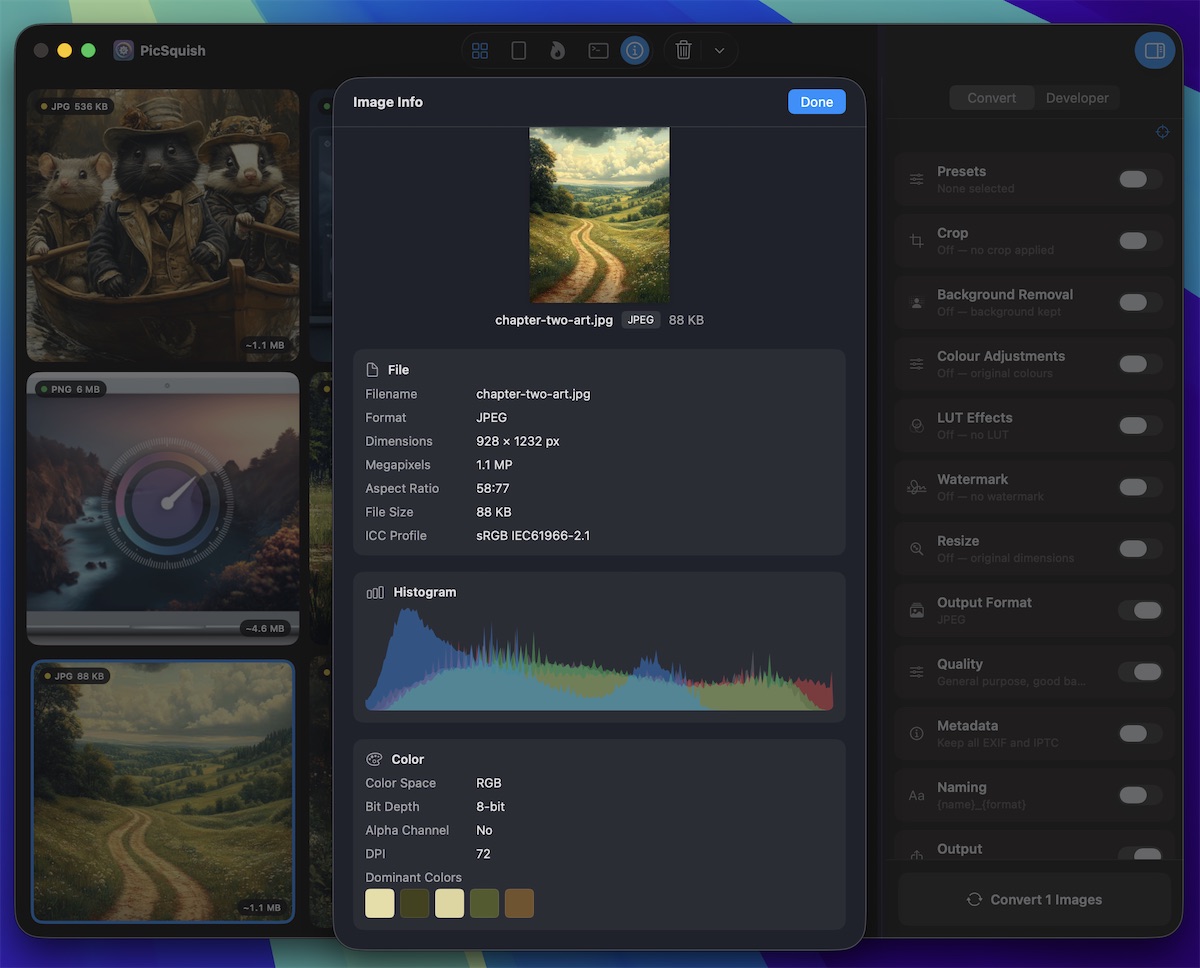
PicSquish includes a searchable metadata viewer that shows you exactly what’s embedded in your images before and after conversion. Browse EXIF, IPTC, and XMP fields, see the colour profile and gamut visualisation, and verify that your metadata preferences have been applied correctly.
Why It Matters
For photographers
Metadata is valuable: it proves ownership, records technical settings, and enables search. EXIF data like camera model, lens, aperture, shutter speed, and ISO are part of the creative record.
For privacy
Metadata can be a liability: GPS coordinates in a photo posted online can reveal your home address, your workplace, or your daily routine. Camera serial numbers and software history can identify you.
PicSquish lets you decide what stays and what goes — every time, for every image.
Enterprise & Sensitive Workflows
If you work with confidential images — medical, legal, financial, pre-release product photography, or classified materials — PicSquish processes everything locally on your computer. There is no cloud component to audit, no third-party data processor to vet, no server to trust.